AI Can Generate Code. Engineers Still Build Software
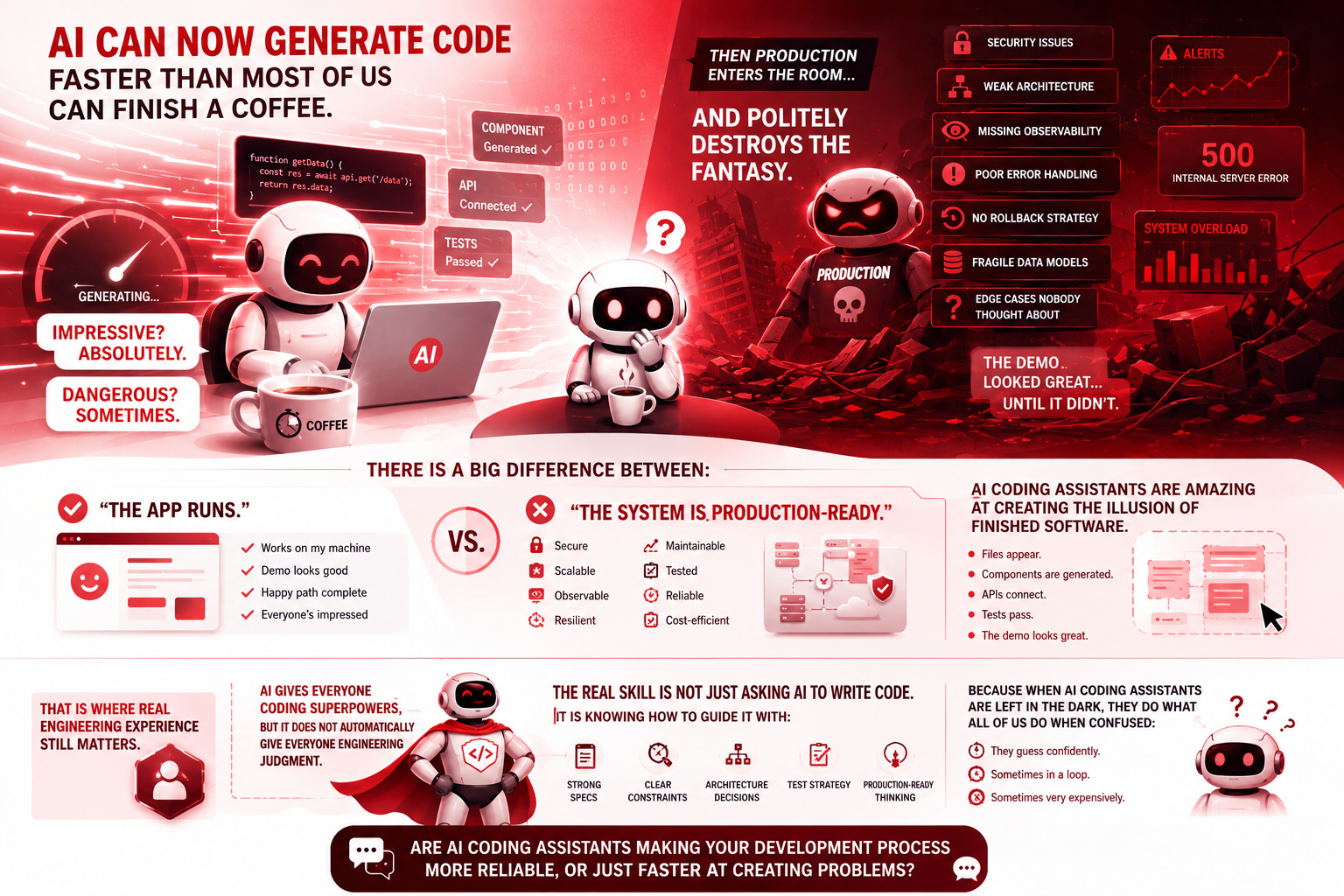
AI coding assistants are becoming incredibly powerful.
They can generate code at impressive speed. They can scaffold applications, write tests, refactor modules, explain unfamiliar codebases, spot obvious bugs, and fix small issues in seconds.
For many developers, they have already become an everyday accelerator.
But after working with AI coding assistants extensively, one thing has become very clear to me:
AI can write code fast. But production-ready software still requires engineering experience.
And that distinction matters.
Because today, many people who have never written serious software before suddenly feel like they have been given superpowers.
In a way, they have.
With the right prompt, they can build a landing page, generate an API, connect a database, create a mobile app prototype, or spin up a SaaS-like product in a few hours.
That is genuinely exciting. It lowers the barrier to experimentation, creativity, and product building.
But there is a hidden problem: many of those solutions will never survive contact with production.
Not because the ideas are bad.
Not because AI coding assistants are useless.
But because building something that runs locally is very different from building something that is reliable, secure, maintainable, observable, scalable, and safe to operate in the real world.
That difference is engineering.
The Illusion of Finished Software
AI coding assistants excel at creating the illusion of rapid progress.
You describe what you want, and suddenly files appear, components are generated, endpoints are created, tests are added, and the app runs.
It feels like software development has become dramatically easier.
And in many ways, it has.
But the danger lies in mistaking this surface-level completeness for true engineering maturity.
AI can produce something that looks finished long before it is actually engineered properly.
A prototype may seem impressive while hiding deep, critical issues:
- Security vulnerabilities
- Fragile or poor architecture
- Missing or inadequate error handling
- Weak or incorrect data modeling
- Lack of observability and monitoring
- No deployment or rollback strategy
- Absence of test discipline
- Ignored edge cases
- No consideration for operational failures
This is where engineering experience becomes indispensable.
An experienced engineer does not just ask:
Does this code run?
They ask:
Can this fail safely without catastrophic consequences?
Can this be debugged effectively at 2 AM under pressure?
Can another engineer maintain and extend this code six months from now?
What happens when the database slows down or becomes unavailable?
How does the system behave if a third-party API is down?
What if user input is malformed or malicious?
Can the system scale from 10 users to 10,000 without breaking?
What are the implications if credentials leak?
Does the AI-generated abstraction remain understandable and maintainable?
These questions are not formalities.
They mark the difference between a flashy demo and a robust production system.
AI-generated code can get you partway there, but only seasoned engineering judgment can bridge the gap to reliable, secure, and maintainable software that survives in the real world.
AI Gives Everyone Coding Power, But Not Engineering Judgment
This is one of the most interesting shifts happening right now.
AI coding tools dramatically reduce the barrier to entry. People who never coded before can now build things that would have been impossible for them just a few years ago.
That is a big deal.
It opens the door to creativity, experimentation, entrepreneurship, and faster prototyping.
But there is also a risk.
When someone without engineering experience uses an AI coding assistant, they may not know when the AI is making poor technical decisions.
They may not notice when the architecture is drifting.
They may not recognize when the implementation is becoming brittle.
They may not understand whether the generated code is secure, testable, maintainable, or production-ready.
The AI can produce code, but it does not automatically produce judgment.
It does not always know the real constraints of your business, your users, your infrastructure, your compliance requirements, your team, or your future roadmap.
And if the human driving the AI cannot evaluate those things, the assistant is effectively working in the dark.
That is when AI coding becomes dangerous.
Not because the AI is bad, but because it is being asked to make decisions without enough context, constraints, and supervision.
The Loop Problem
One of the biggest issues I have noticed with AI coding systems is what I call the loop problem.
When the bug is simple, AI coding assistants are often very good.
They can find a typo, fix an import, update a test, correct a small logic error, or adjust a configuration issue quickly.
But when the bug is complex, things can get messy.
The assistant tries one fix.
The fix creates another issue.
Then it tries another.
Then it reverts part of the previous fix.
Then it changes unrelated files.
Then it starts guessing.
Then it burns tokens.
Then it leaves you with a codebase that is not only still broken, but now harder to understand.
This is where experience matters again.
An experienced engineer knows how to stop the loop.
They know when to stop asking the AI to “try again” and instead step back.
They know how to isolate the problem, reduce the search space, create a failing test, inspect logs, trace execution, reason about state, and identify root causes.
They know when the issue is architectural, not syntactic.
They know when the AI is patching symptoms instead of solving the underlying problem.
Without that guidance, the assistant can keep moving very fast in the wrong direction.
And fast movement in the wrong direction is not productivity.
It is technical debt with better autocomplete.
Specs Are the Real Multiplier
The biggest improvement I have seen in AI-assisted development does not come from better prompts alone.
It comes from better specifications.
Good specs dramatically improve how AI coding assistants build and debug software.
They give the system context.
They define constraints.
They describe expected behavior.
They clarify edge cases.
They explain what should not happen.
They reduce ambiguity.
They prevent architectural drift.
They reduce token consumption during retries.
They lower the bug rate in generated code.
But writing good specs is not trivial.
A weak spec says:
Build a login system.
A stronger spec says:
Build a login system using this authentication provider, with these flows, these error states, these security constraints, this session strategy, this logging behavior, these test cases, these acceptance criteria, and these non-goals.
That difference is huge.
The first prompt invites the AI to guess.
The second prompt gives the AI a controlled environment in which to operate.
This is where experienced engineers have a major advantage.
They know what needs to be specified.
They know which details matter.
They know which trade-offs are dangerous.
They know where bugs usually hide.
They know which constraints prevent future pain.
They know how to describe a system in a way that keeps the AI aligned.
In my own workflow, a spec file for a single use case can easily be 500 lines or more.
That may sound excessive at first.
But those 500 lines are not random text. They are structure.
They include examples, scenarios, constraints, implementation rules, data flows, edge cases, failure modes, expected tests, security expectations, architectural boundaries, and acceptance criteria.
Yes, AI helps me generate those specs.
I use examples, scenarios, and rough implementation ideas as input. Then I use another AI pass to polish, organize, and tighten the specification.
But the engineering judgment still matters.
The AI can help write the spec, but an engineer needs to know whether the spec is good.
Spec-Driven Development Becomes Even More Important With AI
I think AI is pushing us toward a stronger version of spec-driven development.
When humans write code manually, vague requirements are already a problem.
When AI writes code at high speed, vague requirements become a much bigger problem.
Why?
Because AI can generate a large amount of incorrect or misaligned code very quickly.
A human developer might misunderstand a requirement and produce a small wrong implementation.
An AI coding assistant can misunderstand a requirement and generate an entire wrong subsystem.
That is why governance, instructions, best practices, and reusable development patterns matter so much.
In my workflow, I try to structure the development pipeline around reusable skills and instructions.
These define things like:
- Coding standards
- Architecture principles
- Security expectations
- Testing strategy
- Logging and observability rules
- Error handling patterns
- Folder structure
- Review process
- Debugging workflow
- Definition of done
- Rules for when the AI should stop and ask for clarification
- Rules for when the AI should create tests before implementation
- Rules for when the AI should avoid touching unrelated files
This makes the AI assistant much more useful.
It stops being a random code generator and becomes part of a controlled engineering system.
That is the key shift.
The future is not just:
AI writes code.
The future is:
Engineers design systems that allow AI to produce better code safely.
The New Gap: Prompting vs. Engineering
A lot of people talk about prompt engineering.
But in software development, I think the more important skill is engineering-guided prompting.
There is a big difference.
Prompting is telling the AI what you want.
Engineering-guided prompting is giving the AI the right context, constraints, architecture, test strategy, and success criteria so it can produce something usable.
That requires real software knowledge.
It requires understanding not only what to build, but how it should behave under pressure.
This is why I do not believe AI coding assistants eliminate the need for experienced engineers.
If anything, they increase the leverage of experienced engineers.
A strong engineer with AI can move incredibly fast.
They can delegate boilerplate, generate tests, explore alternatives, refactor faster, and document decisions more effectively.
But they are still driving.
They are still making architectural decisions.
They are still validating quality.
They are still thinking about production.
They are still responsible for the system.
Someone without that experience can also build faster than ever before, but often without realizing where the risks are.
That creates a new divide.
Not between people who use AI and people who do not.
But between people who can properly guide AI coding systems and people who simply let them run.
Production Is Where the Truth Shows Up
The real test of software is not whether it can be generated.
The real test is whether it can live.
Can it be deployed?
Can it be monitored?
Can it be secured?
Can it be debugged?
Can it evolve?
Can it survive real users?
Can it survive bad input?
Can it survive partial failure?
Can it survive the next developer touching it?
Production reveals everything that a demo hides.
This is why many AI-generated applications will never see the light of production.
They may look good in a video.
They may work in a local environment.
They may impress during a quick demo.
But once they need authentication, permissions, migrations, background jobs, caching, observability, retries, rate limits, security reviews, backups, CI/CD, secrets management, data consistency, and operational support, the gap becomes obvious.
That gap is engineering.
AI Coding Assistants Need Better Drivers
I do not see AI coding assistants as replacements for engineers.
I see them as powerful accelerators that need skilled drivers.
A junior or non-technical builder can use AI to learn, prototype, and experiment. That is fantastic.
But when the goal is production-grade software, someone needs to bring engineering discipline into the process.
Someone needs to define the specs.
Someone needs to review the architecture.
Someone needs to challenge the assumptions.
Someone needs to design the failure paths.
Someone needs to validate the security model.
Someone needs to decide whether the generated solution is actually good.
The AI can assist with all of that.
But it should not be left alone to guess its way through complex systems.
Because when AI coding assistants are left in the dark, they loop.
They overfit to the latest error.
They patch instead of reason.
They generate instead of design.
They optimize for completion rather than correctness.
And that is how you end up with buggy solutions that look finished but are not production-ready.
The Real Skill Is System Design Around AI
The more I use AI coding systems, the more I believe the real advantage is not just knowing how to prompt.
The real advantage is knowing how to build a development system around the AI.
That includes:
- High-quality specs
- Clear architectural boundaries
- Reusable engineering instructions
- Strong test strategies
- Tight feedback loops
- Good debugging workflows
- Explicit acceptance criteria
- Human review at the right points
- Governance that prevents uncontrolled changes
- A clear definition of production readiness
When these pieces are in place, AI coding becomes dramatically more effective.
It consumes fewer tokens.
It makes fewer wrong turns.
It produces cleaner code.
It debugs more effectively.
It stays aligned for longer.
It becomes easier to trust, because it is operating inside a structured process.
And the whole development pipeline becomes much more enjoyable.
In fact, sometimes I intentionally introduce bugs just to evaluate whether my specs are good enough for the AI coding assistant to detect and fix them.
That may sound strange, but it is a useful test.
Because if the assistant can fix a bug only when I explain everything manually, my system is not good enough yet.
But if the assistant can detect the issue, understand the context, follow the specs, write or update the tests, and fix the problem without drifting, then the process is working.
Final Thought
AI coding assistants are changing software development.
They make coding faster.
They make prototyping easier.
They give non-technical people new creative power.
They give experienced engineers massive leverage.
But they do not remove the need for engineering knowledge.
They make engineering knowledge more important.
Because the bottleneck is no longer just writing code.
The bottleneck is knowing what code should exist, why it should exist, how it should behave, how it should fail, how it should be tested, and how it should survive production.
AI can generate code.
But experienced engineers turn that code into systems.
And that is the difference between a prototype that looks impressive and software that actually lives in production.
Written by
Dario
Dario is a senior Data & AI / Cloud Architect and certified in PMP, TOGAF and SAFE with over 20 years of IT experience, specialized in AI platforms and data-driven architectures in the Azure Cloud.