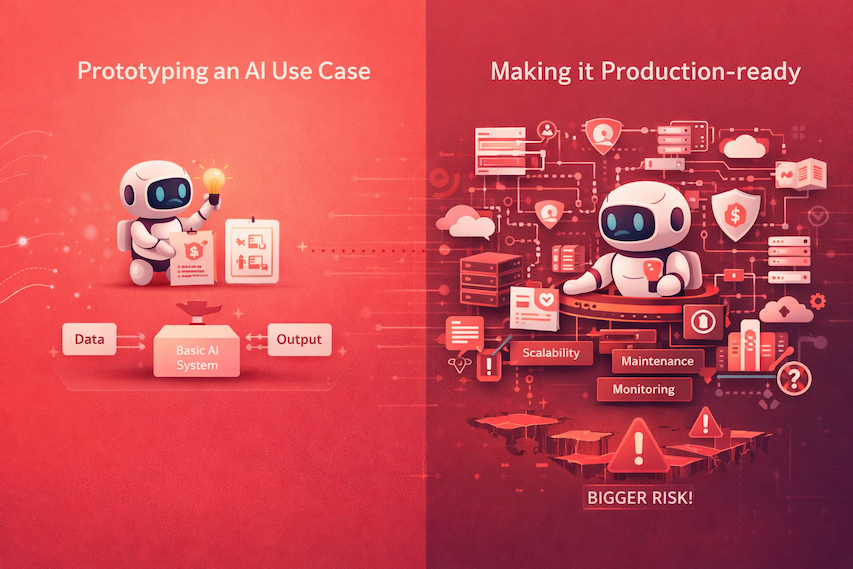
Prototyping an AI Use Case versus Making it Production-ready
Prototyping an AI Use Case versus Making it Production-ready
Over the past two years, I've immersed myself in building AI systems and workflows using various frameworks. I still vividly recall my early attempts at creating an AI agent, back when the term "agent" was not widely recognized and tools like LangChain were still on the horizon. Since then, the landscape has transformed dramatically.
The Rise of AI Agents
Today, countless individuals are venturing into the realm of AI agents and MCP servers. The accessibility of these concepts has empowered even those without a deep development background to experiment and innovate. However, this surge in experimentation has led to a mixed bag of outcomes: while some have achieved success, many have faced failures, and others have deployed systems that lack reliability.
Lessons Learned from Experience
I count myself among those who have mistakenly transitioned promising implementations into production, believing they were stable enough to endure over time, luckly these were my pet-project. This experience has taught me valuable lessons about the pitfalls of treating MVPs as production-ready solutions.
The Monolith vs. Microservices Debate
One of the first insights I gained during my architecture reviews daily job is that many AI-based implementations rely on monolithic architectures. While frameworks like LangGraph are excellent for developing quick PoCs or MVPs, they can lead to significant challenges as applications scale.
Monolithic architectures can be effective for small, rapid solutions, but they often fall short when an application is designed for growth. As organizations aim to expand their applications, transitioning to microservices-based architectures becomes essential. Microservices allow for faster development, domain-specific federations, and independent deployment, making them ideal for large enterprises.
Evaluating Your AI Solution
The first step in ensuring a reliable AI system is to assess whether your solution is intended to be a simple project or a scalable application that will incorporate new components, such as additional AI agents. For scalable solutions, I recommend considering the Agent-to-Agent (A2A) protocol. This approach promotes the use of independent AI agents that expose their own well-known endpoints, facilitating automatic discovery and reusability.
Avoiding the Prototype Trap
To prevent the common trap of moving a quick prototype into production, there are several key considerations:
1. Implement a Gateway
A centralized gateway is crucial for addressing security concerns, including authentication, authorization management, and the establishment of guardrails. In the context of AI, these guardrails are vital for building reliable solutions and mitigating risks associated with adversarial prompting, whether from user interfaces or AI agents themselves.
2. Embrace Observability
Monitoring an AI system differs significantly from monitoring traditional deterministic software. While the latter can be straightforward, tracking the performance of non-deterministic AI solutions can be complex. This concept, often referred to as observability, involves not just checking system stability but also understanding how AI agents behave against measurable benchmarks and expected outcomes.
Fortunately, there are numerous emerging tools designed to automate the observability process, enhancing our ability to track AI performance. However, observability alone is insufficient; it must be paired with rigorous evaluation. By assessing your AI agents before deployment, you can establish metrics and expected outcomes that serve as parameters for continuous monitoring in a production environment.
3. Establish a Safety Mechanism
In addition to observability and evaluation, it is essential to have a "big red button", a mechanism that allows you to halt operations if something goes awry. This safety feature is critical for maintaining control over your AI systems.
The Transition from Prototype to Production
As you can see, transitioning from a prototype, PoC, or MVP to a production-ready solution is a significant leap. It requires careful planning and consideration to ensure reliability and stability over time.
Moreover, it's important to recognize that we have shifted from a cost-versus-benefit analysis in software solutions to a risk-versus-benefit perspective in AI-based solutions. While the potential benefits can be substantial, they come with inherent risks. Therefore, it is crucial to approach AI development with caution, especially in large enterprises where the stakes are high.
Written by
Dario
Dario is a senior Data & AI / Cloud Architect and certified in PMP, TOGAF and SAFE with over 20 years of IT experience, specialized in AI platforms and data-driven architectures in the Azure Cloud.